
The government has issued a revised plan for the National Land Use Planning for the period 2021–2030, with a vision to 2050, to meet land use needs for socio-economic development goals in the 2026–2030 period. The plan aims for an average GDP growth rate of 10% or more per year, a GDP per capita of approximately US$8,500 by 2030, a manufacturing and processing industry share of approximately 28% of GDP, and a digital economy share of approximately 30% of GDP.
According to the revised plan, land will continue to be prioritized for national defense and security, infrastructure development, industry, services, and urban development to create growth momentum. Simultaneously, the State maintains a reasonable area of rice-growing land to ensure national food security, strictly manages protective and special-use forests, protects and restores natural forests, rehabilitates degraded land, and continues to reclaim, restore, and utilize unused land effectively in line with sustainable development goals.
By 2050, land resources will be used efficiently to meet the requirements of industrialization and modernization of the country. Land use space will be allocated based on the potential of agricultural ecological zones, coastal economic corridors, and six socio-economic regions, ensuring harmony between economic development and environmental protection, biodiversity, food security, and national defense.
For each region, the plan identifies development orientations suitable to its specific advantages. The Northern Midlands and Mountains region focuses on forest protection, border gate economic development, efficient resource exploitation, and tourism. The Red River Delta is promoting the development of smart cities, industry, services, and innovation centers, while also developing high-tech agriculture and agricultural processing industries. The North Central region prioritizes forest protection, marine economic development, coastal urban systems, seaports, and seafood processing. The South Central Coast and Central Highlands focus on developing renewable energy, processing industries, transportation infrastructure, tourism, industrial crops, medicinal plants, and production linkages. The Southeast region is oriented to become a driving force with an international financial center in Ho Chi Minh City, developing industrial-urban chains, the Cai Mep-Thi Vai seaport, Long Thanh airport, and ecological agriculture. Meanwhile, the Mekong Delta continues to develop large-scale commercial agriculture, organic farming, agricultural and aquatic product processing, building value chains for rice, fruit, and seafood, while strengthening its ability to adapt to climate change and sea level rise.
The land use targets for 2030, as outlined in the revised National Land Use Plan, are as follows:
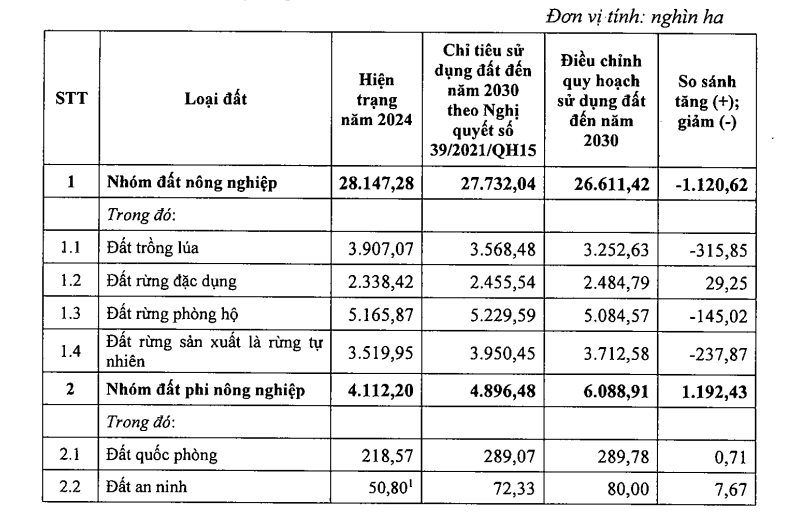
Source: Decision No. 1177/QD-TTg dated June 30, 2026
To implement the plan, the Government has outlined six key solution groups: perfecting mechanisms and policies; promoting the application of science and technology; protecting and improving land and the environment; organizing the implementation of the plan; mobilizing resources; and disseminating information and raising awareness. Among these, digital transformation is identified as a key solution, involving the construction of a unified national land information system and database, connected to national databases. AI, big data, blockchain, GIS, and remote sensing technology will be applied to manage and monitor land use changes, provide early warnings of planning violations, enhance transparency, and facilitate access to information for citizens and businesses.
In addition, the Government requires continued review to ensure consistency between land use planning and sectoral and local planning; strengthening inspection and enforcement, and strictly handling cases of land misuse, pollution, waste, or delays in land utilization. Local authorities will publicly disclose slow-moving projects, resolutely reclaim land used inefficiently, and strengthen supervision by management agencies and the community to ensure that planning is implemented synchronously, effectively, and sustainably.
Source: Government Electronic Newspaper
Download link:: Quyết định số 1177/QĐ-TTg